The Pollination Security Status Report 2026 establishes a national baseline for understanding how Australia’s pollination system is changing over time, bringing together new modelling, economic analysis and industry data.
It provides new modelling that compares pollination demand with the estimated availability of managed honey bee hives during peak flowering periods.
At the official launch this week at Hort Connections in Adelaide, Wheen Bee Foundation CEO and Australian Pollination Strategy Steering Committee Chair Fiona Chambers presented the key findings and highlighted risks facing Australia’s pollination system.
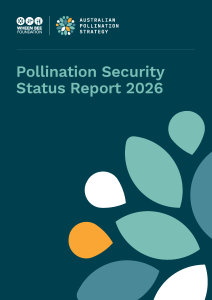
Read the full report HERE.
Ten key findings from the Status Report
- Australia’s pollination system is under increasing pressure
- Varroa mite is the most immediate threat to pollination
security - Structural challenges within the beekeeping industry are
reducing resilience - Pollination security is critical to Australian agriculture
- Pollination delivers value that extends beyond agriculture
- Pollination underpins biodiversity
- Pollination is essential to ecological resilience
- Pollination supports important social and cultural values
- Significant knowledge gaps limit Australia’s ability to as-
sess pollination security - Pollination security requires greater national attention
From the point of view of native bees, ANBA readers may be interested in reading that of the 22 crops predicted to be impacted by this shortage, seven can also be pollinated by native stingless bees, (namely avocadoes, blueberries, macadamias, mangoes, melons and strawberries). It is also significant that Queensland is the state that is predicted to experience the most hive shortages, followed by NSW. These are the two states where the stingless bee industry is most active ANBA encourages the research and development of the native bee industry to relieve some the pollination deficit in the relevant crop industries.